Why “All Lives Matter” is problematic

By: Alexxa Rojas

Dominating the current socio-economic climate, the death of George Floyd in May of 2020 stimulated the boiling point of an ongoing nationwide movement titled ‘Black Lives Matter.’ The movement, founded in 2013, was in response to the acquittal of Trayvon Martin’s murderer. Overall, the ‘Black Lives Matter’ movement sheds light and brings awareness to the unjust racial profiling of black lives in the circumstances of police brutality. The simple phrase, as stated from their organizational webpage, is an “affirmation of Black folks’ humanity, our contributions to this society, and our resilience in the face of deadly oppression.”

What does this have to do with ‘All Lives Matter?’ Well, opponents to the movement use this term as a counterargument or replacement to the original “Black Lives Matter” implying that the movement’s slogan suggests Black lives matter more than those of others. On the surface level, the phrase “All Lives Matter” seems well-intentioned, seeming to support equality on all levels regardless of any category of one’s identity. However, in reality, the idea that this phrase is simply ‘well-intentioned’ is entirely ignorant and insensitive.

As a counter-argument or rebuttal to ‘Black lives matter’, the phrase “All lives matter” acts to suppress and invalidate the real problem that Black people are facing in the real world. A popular cartoon created by Kris Straub demonstrates the issue with the phrase. Seen from the image, if a house is burning down, you’re obviously going to focus on putting out the fire instead of watering a house that’s just fine. In this analogy, black lives are the burning house, and everyone else is living much more comfortably in the house that isn’t burning down. Clearly, one is a bigger problem. The point of Black Lives Matter, both the phrase and the movement, isn’t suggesting that black lives are more important than other lives, rather, black lives are maltreated and insignificant; as a nation, we need to recognize that. Like past president Barack Obama says on the usage of both phrases, 
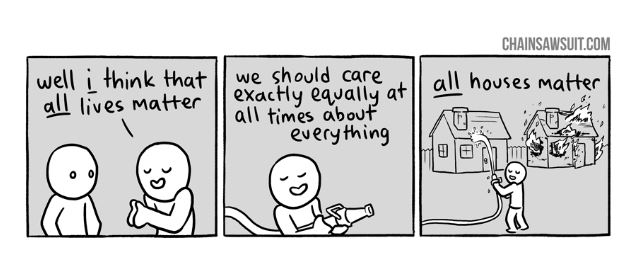
Photo for All Lives Matter

“I think it’s also important for us to understand that the phrase ‘Black Lives Matter’ simply refers to the notion that there’s a specific vulnerability for African-Americans that needs to be addressed. It’s not meant to suggest that other lives don’t matter. It’s to suggest that other folks aren’t experiencing this particular vulnerability and so we shouldn’t get too caught up somehow in this notion that people who are asking for fair treatment are somehow automatically anti-police or trying to only look out for black lives as opposed to others…” 

Using the phrase “all lives matter” is downplaying a real problem we face as a society, the hundreds, thousands, of unjust deaths of innocent black lives because of the corrupt hand of law enforcement is not something to be placated or pacified with a vague and ignorant expression. The legal system made to protect innocent civilians is actually inflicting more harm introducing the question of who the real villains really are. When those who hold a large, overwhelming position of authority and power abuse this for the intentional demise of a certain group of innocent lives, said the system needs a serious culture change.

 Instead of saying “all lives matter,” try to recognize that in order for real change to happen, address issues, don’t go around them or bypass them for a more ‘comfortable’ viewpoint. All lives don’t matter until black lives do.
The Media Distorting Riots and Violence

By: Irene Kim

Many of us agree that we are against the ideas of looting and violence that are affiliated with the protests. However, there are several large misunderstandings when it comes to this topic which has divided and distracted the focus away from the point of the movement. Before I start, what is most important to understand is that if the police did not brutally murder hundreds of lives, these protests would not have happened on such a massive scale in the first place. 

First, the majority of BLM protestors are NOT inciting violence or looting. They are white supremacist groups, disguised police officers, or unaffiliated local residents desiring to take advantage of the movement. The intentions of these people are usually to force the protests into a negative light by the media, which is evidently working. There are clear videos of the BLM protestors PLEADING those not affiliated with the movement, (white supremacists, disguised officers, etc.) to stop the violence because they are aware they will be framed for the looting that they did not commit.

Moreover, the POLICE are inciting most of the violence. These protests all start in a nonviolent manner, but the police have been unnecessarily using tear gas and rubber bullets. Search up what happened when Trump decided he wanted to walk to a deserted church to hold a photoshoot — it portrays one example out of many. Some examples are pregnant women being stomped on the stomach and getting a miscarriage, a 70-year-old blind man being killed, the police pushing over a paralyzed man and several elderly, the police macing 8 and 13-year-old children, the police beating up protestors for no reason, and the police purposefully ripping off a protestors’ mask to direct the tear gas into the eyes and face of a protestor.

Here are some sources:

Second, if you are reading this and decided to point out the looting and violence, but have not promoted the Black Lives Matter movement other than a black square, you need to reprioritize. Your attitude shouldn’t be “A man was killed, but looting is wrong!” but “Looting is wrong, but thousands of people other than George Floyd were brutally killed by people designated to protect us!” The media purposefully tries to focus on this aspect of the protests to distract away from the movement.

Did you see mass news coverage when our citizens would burn down buildings because their sports teams lost? When citizens had rifles in their hands, shouting at the police to stop quarantine because they wanted a haircut? If you didn’t become outraged and hold these people accountable in the past when they burned down small businesses, don’t suddenly become all outraged now when discussing BLM. And, remember that the police ALLOWED “several hundred protesters to peacefully enter the capitol building around 1pm, where they crammed shoulder-to-shoulder near the entrance to legislative chambers” when white people tried to protest against the virus.

Third, EVEN if they DID incite some sort of violence, how are you going to criticize their methods when they’ve been brutally oppressed for years? If you don’t truly understand what Black minorities have gone through ever since they stepped foot on American soil, here is a quick rundown:  

*TRIGGER WARNING* 

Black minorities were raped, enslaved, lynched, their teeth were used as dentures, they slashed pregnant women’s bellies open and stomped on their babies as they watched, they would force the son to rape their parents so they wouldn’t need to buy new slaves, utilized Black people for the Tuskegee experiment, exhibited a man named Ota Benga in a zoo’s monkey house, tied pregnant women to trees to allow cats to attack their bellies, had carnival games where they would “hit the n****** baby.” The word “picnic” morphed into “pick a n******” to watch them get hanged. I could continue.

So yes, I’m against looting and violence, but have I witnessed my brother being shot to death for buying a pack of Skittles? I don’t even think I would have the self-control to peacefully protest if that happened to me. No one is saying this violence is okay, but do you not see the mass news coverage, now that rioting has occurred? Black Lives Matter protests have occurred since 2013, but they are just now getting news coverage. Why didn’t we ALL say BLM 7 years ago when it first started, when Trayvon Martin’s death, Eric Garner’s death, was JUST as brutal as George Floyd’s? What is the ONE thing that changed?

Martin Luther King Jr said, “Rioting is the language of the unheard.”

If the BLM movement wasn’t heard before, it sure will be now.

There is never a RIGHT way to protest; protesting is ACTIVELY GOING AGAINST the system. When Colin Kaepernick kneeled they said, “this is not the right way.” When MLK had children protesting with him in Birmingham, people said “this is not the right way.” When he marched in Selma, people said, “this is not the right way.” It’s never the right way because that’s the POINT of protests. Also, when MLK was assassinated, rioting occurred for SIX DAYS before laws were finally passed.

Stop and ask yourself why you’re so angry over property being destroyed instead of realigning your voice to try and spread justice for all of the lives we’ve lost by the hands of cops just because of the color of someone’s skin. People are allowed to be angry and have grief — and although a majority of this violence is not done by BLM protestors, I hope I was able to convey that sometimes the protestors’ grief will be shown horribly, but unless it affects your directly, you have no say in how they get to express their pain. None.


Television Industry: Impacted by the Coronavirus

By: Eli Engler

The last time that the television industry shut down similar to how it has been shut down now was in late 2007 and early 2008, during the Writers Guild Strike. With the production of just about all television shows suspended due to safety concerns related to the coronavirus, the television industry faces its biggest challenge since 2008. In the upcoming months, with social distancing and other health guidelines still likely to be in place, television producers and executives will face an important dilemma.

First, it is necessary to look at exactly how the coronavirus stopped television production and why these shows had to stop filming. While it is obvious that certain industries, such as restaurants, had to change their business model in order to maintain safety, one might think that television productions would be able to continue to be produced because there are not that many people working on each scene at a given time. However, this is not the case as even small television productions can have hundreds of people working on the show in a small area.

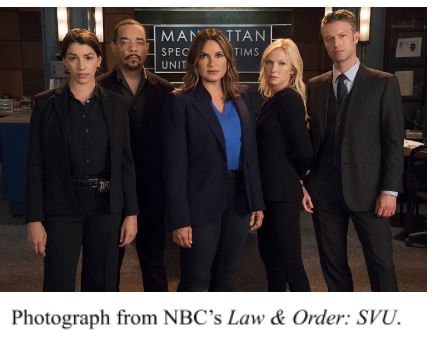
In particular, scripted shows were hit the hardest by these safety concerns. For example, one show that had to stop filming was Law & Order: Special Victims Unit, also called SVU. Filmed in New York City, SVU shut down in March due to the high coronavirus concerns in New York. Showrunner Warren Leight explained why SVU had to shut down. In an interview with Vanity Fair, he said that while shooting courtroom scenes, “we might have 100 extras in there.” He also said that while filming the show in early March, he realized “this is scary” as he considered the potential risks of having so many workers working closely together at one time.

Photo for Television Industry 1

In addition, the danger of the coronavirus to the television industry was shown in a sad story revolving around SVU. In early March, costume designer Josh Wallwork went home early one day as he was feeling sick. He would later die due to the coronavirus, showing how dangerous the coronavirus could be to television productions. If just one crewmember got the coronavirus, they could potentially spread it to hundreds of people, making it an easy decision for Leight to have to shut down production of SVU in March.

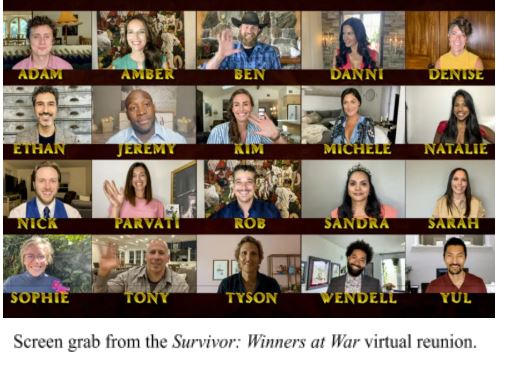
Besides scripted cable shows, other television productions were also impacted. For instance, the reality show Survivor was affected by the coronavirus. Survivor’s fortieth season started airing in February and its finale was scheduled for May 13th. Typically, at the end of each season, there is a live Survivor reunion show where all the cast members get together to talk about the season. However, due to the coronavirus, Survivor decided to scrap the idea of a live reunion due to safety concerns.

Photo for Television Industry 2

Furthermore, the forty-first season of Survivor was supposed to start filming in March in Fiji. However, production on this season was suspended. In the Survivor season forty reunion show, host and executive producer Jeff Probst said that they are committed to having the next Survivor season on air in the fall. Many fans were skeptical that Survivor would be able to return with all the health and travel restrictions currently in place. One current rumor suggests that season forty-one of Survivor is actually filming right now somewhere in the United States to get around the international travel bans, particularly the one currently in Fiji where Survivor was supposed to film.

Although the shows that were set to film in March and beyond were messed up by coronavirus, many other shows have already been filmed but not released yet. This gives television producers a big decision to make – should they air these shows now in order to fill the holes in their summer schedules or hold onto these shows for the fall, when they potentially may have bigger holes in their schedule they need to fill. This dilemma affects all television producers and executives as they have to choose whether to put out their new content in the summer or the fall.

In an interview with The Hollywood Reporter, a television executive discussed the problems that executives from all networks are facing. The executive said, “Scheduling is about having all the pieces of a puzzle in front of you and how you put them together to generate the highest rating… It’s impossible to do that when you don’t know what all the pieces are.” All television networks now have to address this problem and decide when to air their limited new content.

Overall, the impact of the coronavirus on the television industry has been large. The production of all kinds of shows that were originally intended to be released in the fall has been delayed. Now, networks and producers have to decide when is the best time to release their new content because they may not be able to produce any more in the coming time.

Bibliography

George, Daniel. Screen Grab of Virtual Reunion from Survivor: Winners at War Finale. Fansided, 2020, https://survivingtribal.com/2020/05/14/survivor-winners-war-final-six-favorite-moments/

Goldberg, Lesley. “A Puzzle Without All the Pieces: Broadcast Networks Scramble to Program an Uncertain Future.” The Hollywood Reporter, 7 Apr. 2020, www.hollywoodreporter.com/live-feed/a-puzzle-all-pieces-broadcast-networks-scramble-program-an-uncertain-future-1288828.

Merrett, Robyn. Photograph from NBC’s Law & Order: SVU. People.com, 5 June 2020, https://people.com/tv/law-order-svu-will-address-george-floyd-and-coronavirus-in-new-season/

Porter, Rick. “’Survivor’ Plans Virtual Reunion for Season Finale.” The Hollywood Reporter, 13 Apr. 2020, www.hollywoodreporter.com/live-feed/survivor-plans-virtual-reunion-season-finale-1289993.

Press, Joy. “The Week the Cameras Stopped: TV in the COVID-19 Era.” Vanity Fair, 23 Apr. 2020, www.vanityfair.com/hollywood/2020/04/the-week-the-cameras-stopped-tv-in-the-covid-19-era.

The Impact of BLM on Businesses

By: Lauren Vergos

The killing of George Floyd on May 25th was the catalyst for new conversations and change surrounding the Black Lives Matter movement. Social media is flooded with posts raising awareness, protests are occurring across the country, and change for the better is starting to happen. The world has been greatly affected by the movement in the last month, both socially and politically. Businesses, both large and small, have been particularly impacted.

Many large corporations have expressed their support of the BLM movement. More often than not, major businesses choose not to express their views regarding sensitive topics in fear of offending their customers. Despite this, companies like Netflix, Ben & Jerry’s, Nike, Twitter have aligned themselves with BLM. Other companies have received backlash after releasing statements regarding the movement, such as YouTube. They promised to spend $1 million on social justice initiatives, but then quickly faced criticism that their moderation against racist content has consistently been weak. Clothing brands that capitalize off of black culture like Fashion Nova have been urged to weigh in on BLM by social media influencers. Jackie Aina, with over 3 million subscribers on YouTube, asked for these companies to use their platforms for the movement. “When it comes to relevant things happening, things you can’t ignore like the Black Life Matters movement, police brutality or murders in our community, it’s crickets, and that’s unacceptable. If you are capitalizing off of a culture, you’re morally obligated to help them.”

On the other hand, many people have taken to social media to list businesses that do not support BLM in order to boycott their products and services. Activists have organized Facebook groups to vote on and decide which companies to boycott that have either expressed anti-black values or remained completely silent in these times. Carmie Basnight, the co-organizer of Boycott for Black Lives,  said that “Our hope is that companies will acknowledge the strength of Black people’s buying power, as well as our collective buying power with our allies.” These same groups are also encouraging people to buy from black-owned businesses. Their efforts will aid in closing the racial wealth gap as well as strengthening local economies.

BLM is not a simple trend that will go away anytime soon. People will not rest until the goals of the movement are achieved, which could easily take years. Therefore, it is imperative for businesses to make their intentions regarding the movement clear. Otherwise, they will be subjected to boycotts and criticism, and rightfully so.

Why the Oakland Raiders Are Moving to Las Vegas

By: Ethan Donovan and Eli Engler

Back in March of 2017, the Oakland Raiders received approval from the NFL owners to move to Las Vegas. However, the Raiders are now finally moving to their new stadium in Las Vegas and will play there, starting in the 2020 season. The Raiders have been a part of the NFL since 1959 and have played in both Los Angeles and Oakland, but this is their first time playing Las Vegas. Despite moving to Las Vegas, a city associated with gambling, the Raiders and the NFL have said the move has no official ties to the gambling business in Las Vegas.

The Raiders have a history of moving quite often between cities, as they started as a franchise in Oakland, but moved to Los Angeles in 1982. Just 13 years later, they moved back to Oakland. Other NFL teams are currently experiencing similar problems to the Raiders, as the Los Angeles Chargers and Los Angeles Rams recently moved from San Diego and Saint Louis, respectively. NFL Commissioner Roger Goodell does not believe team relocation is good for the NFL, saying “We work very hard, and never want to see a relocation of a franchise.”

The main reason that the Raiders are moving to Las Vegas is the stadium issue that the Raiders had in Oakland. The Raiders were in need of a new stadium since 2015, but Oakland’s proposal for the new stadium was rejected by the NFL. In 2016, Los Angeles sent a proposal for a stadium for the Raiders as well, but the NFL rejected their proposal too. Finally, Las Vegas sent in a stadium proposal that was accepted by the NFL. The new stadium in Oakland will be funded both privately and publicly, something the city of Oakland refused to do. In total, the stadium will cost $1.7 billion, with $750 million of public funds being invested in the stadium. Bank of America will also help to finance the stadium. 

So will the Raiders be successful in Las Vegas? History has no definite answer. For some NFL teams, relocation has been a catalyst for positive change. After the 1963 Chiefs moved from Dallas to Kansas City, they have won the Superbowl and reached the playoffs 17 times, cementing a long and fruitful future as a franchise. The Browns moved from Cleveland to Baltimore in 1996, becoming the current Baltimore Ravens. The Ravens were revitalized following their move, making the playoffs 10 times in 21 seasons and winning the Super Bowl twice. However, relocations have not all been successful. Some teams were unchanged or even negatively affected, such as the 1960 Cardinals, which were forced to move again after their relocation to St. Louis yielded no more success on the field or monetarily.

So far, the Raiders have appeared to gain financially from their relocation. After announcing their move from Oakland to Las Vegas, their valuation has increased by roughly $1 billion. Prior to the news of relocation, the Raiders were noted as the 31st most valuable team with a valuation of only $1.43 billion. Their current valuation of $2.42 billion makes them the 18th most valuable team in the NFL. The cause of this notable increase is due to the building of their $1.7 billion dollars stadium. The Raiders are expected to make $250 million per year in personal seat licenses, a sum that will be used to pay off the debt they have accumulated from building their stadium.

Furthermore,  Las Vegas, a city built off of terrorism, expects to benefit off of the move as well. Per New York Times, Las Vegas hopes to pay off their $750 million contribution to the Raiders stadium through an increase in tourism. Many believe that the city will not see enough extra tourism for this to make a difference, yet others disagree. Jeremy Aguero, an analyst for the new Las Vegas Stadium, predicts 35% of Raider’s game attendees to come from outside the City, each fan staying an average of 3.2 nights and spending $820 per trip. The funds raised from increased tourism coupled with an increase in the hotel tax of Las Vegas is hoped to eventually make the city’s investment profitable.

Sources:

https://www.nbcsports.com/bayarea/raiders/oakland-raiders-are-moving-las-vegas

https://www.raiders.com/history/timeline

https://www.sportingnews.com/us/nfl/news/raiders-las-vegas-move-timeline-nfl-explanation-stadium-roger-goodell/jc4lwx7zbfgw1lo5xjfe6sq8g

https://www.freep.com/story/sports/nfl/lions/2017/01/15/nfl-relocations/96609592/

https://lasvegassun.com/news/2018/sep/25/forbes-raiders-valuation-soars-to-24-billion-after/

Bolton and the Impeachment Process

By: Irene Kim

With Trump being the 3rd president in the United States to ever be impeached, a large majority of the news coverage surrounds his impeachment. However, recently, a huge leak, described as a “New York Times bombshell,” has occurred. John Bolton, Trump’s former national security advisor, was discovered to have been writing a book called “The Room Where It Happened: A White House Memoir.” It summarizes many of what Bolton saw himself while coordinating and working directly with Trump throughout the circumstances with Ukraine. New York Times was able to obtain a draft manuscript for his book which mentioned that Trump had asked him to condition Ukraine security assistance on investigations into former Vice President and 2020 candidate Joe Biden. More specifically, the manuscript describes Trump directing Bolton to ask the Ukrainian president to meet with Trump’s attorney Rudy Giuliani. 

As soon as this news appeared, many of the Democrats especially wanted Bolton to testify and see Bolton’s manuscript. On the other hand, Trump’s defense team argued strongly against it. For instance, Trump’s lawyer Dershowitz said, “”Let me repeat: Nothing in the Bolton revelations — even if true — would rise to the level of an abuse of power or impeachable offense.” Many Republican senators also supported Dershowitz. Senator John Corwyn said, “Democrats have a credibility problem.”

Although the book is scheduled to release in March, the White House is extremely opposed to it. Bolton may face many legal obstacles. The National Security Council warned Bolton’s attorney that it would need revision, as it had “significant amounts of classified material.” Officials said the White House would use its resources to delay the publication of the book as much as possible. Other books, such as “Holding the Line: Inside Trump’s Pentagon with Secretary Mattis,” had also been delayed up to six months by the Defense Department for a security review. It was allowed to be published only after a suit was filed against the department for blocking the author’s publication. 

With a Republican majority Senate, the Senate has evidently voted to not bring witnesses in for trial; it would stain their reputation as well as Trump’s. However, it is undeniable that Bolton’s evidence and outspokenness has caused disarray in the impeachment process. 

The Current Deal with Marijuana: 2020 and Beyond?

By: Veronica Baladi

Whether this plant is known as “pot,” “weed,” or “420,” the legalization of cannabis both medically and recreationally is a sensitive, highly debated topic across the United States. Especially with the Presidential Elections of 2020 on the horizon, the plethora of opposing views and reasoning behind them is quite a great deal to process.

In order to truly understand the significance of this hallucinogen to Americans, it is important to conjure up an idea of the past of marijuana itself and its surprisingly profound impact on American history. Art icons such as the hit Reggae singer/songwriter Bob Marley and notorious guitarist Jimi Hendrix were avid cannabis users. Marley called cannabis “an aid to meditation” at one point, which rebelled to common views to marijuana at the time. However, medical experts may view the use of cannabis as harmful, and is a taboo topic to civilians.

The use of cannabis has always been a controversial topic, and has never truly been completely resolved on a federal level; this is questionable especially considering how long it has been in the public eye, and the politicians of 2020 each have their own sort of stance on the legalization of marijuana federal level, which depict that this argument has been evolving.

This raging debate is even causing divides between individual political parties themselves. About 49% of Democrats support legalization, and 50% of Republicans are opposed showing a divide in both parties on the stance of this issue.

But, the arguably most significant opinion about the legalization of marijuana is that of the American population, as the United States is a democratic republic and that each level of legalization impacts this group. Pew Research studies display about 6-in-10 Americans overall think marijuana should be legalized.

When it comes to the Presidential race of 2020, almost all democratic candidates, with the exception of Joe Biden, support the legalization of marijuana, which may seem surprising because a majority of American democrats do not appear to support this. President Donald Trump’s position, on the other hand, is unclear, so this issue is not very prevalent to him.

Especially with the arrival of the 2020 elections nearing, this issue is still up in the air for all parties and candidates. For now, the status of marijuana remains on the state level.

https://disa.com/map-of-marijuana-legality-by-state

https://www.delawareonline.com/story/news/2018/11/01/politics-and-pot-how-do-democrats-and-republicans-use-cannabis/1823707002/

https://iop.harvard.edu/survey/details/political-issue-marijuana

Jerry Garcia

Paprocki, Sherry; Dolan, Sean. Bob Marley: Musician. p. 51.

https://www.usatoday.com/story/news/nation/2019/09/07/2020-what-biden-warren-and-sanders-said-marijuana-legalization/2079187001/

https://time.com/5603016/marijuana-legalization-democratic-presidential-candidates/

Iranian Protests Strike at the Regime

By: Alexxa Rojas

Protests erupted all across Iran in current days after an abrupt government decision to boost petrol charges in an effort to fill the crippling budget deficit stemming from the effects of US sanctions on the country’s economic system. The protests commenced within the night of November 15 and within hours circulated to 21 cities as videos of the protest started to spread online. The movement motivated demonstrations in towns and cities throughout Iran, with drivers abandoning vehicles on highways and protesters blocking roads and dozens of banks and stores being set afire and damaged With at least 180 people killed, and possibly hundreds more, Iran is experiencing its deadliest political unrest since its revolution 40 years ago. Although the protests started as peaceful gatherings, they soon turned into violent riots and rebellion towards the Iranian authorities. The Iranian government utilized several techniques to shut down the protests including a nationwide internet shutdown and, consistent with Amnesty international, capturing protesters lifeless from rooftops, helicopters, and gunfire. According to witness accounts and videos, security forces opened unprecedented fire on unarmed protestors, largely unemployed or low-income young men between 19-26, according to witness accounts and videos. This unjustified violence created the fuel for the rising anger of protestors throughout Iran.

While protestors are primarily driven by petrol prices, the price increase was nearly the tipping point of a growing economic crisis. Job opportunities have diminished greatly and the ability to stay afloat has become nearly impossible amid extremely high inflation rates, which sent 1.6 million Iranians into poverty in just one year.  The protesting is so much more than a hike in oil prices, but rather an uproar towards the government corruption and theft of the Iranian government. Reza Khaasteh, reporter and editor for an Iranian page news site based in Tehran says in his interview with Vox Newsletter, “Frustration is very widespread now. The government needs to do much more to regain the trust [of the people]. But it’d be very, very difficult. … The decisions made by the government were wrong moves in the wrong time, as the people were already struggling under the US sanctions, and could not stand any more economic pressure.”

Agreed by the Supreme Council of Economic Coordination, the body decided that vehicles for private use would be restricted to 60 litres of fuel monthly, while the price of petrol would jump 50 percent to 15,000 Iranian rials per litre. Any fuel purchases in excess of allotted rations will be imposed on an additional charge of 30,000 rials per litre. Despite the fact that petrol remains cheaper in Iran than a large majority of other places around the world, average incomes are too low to adapt to the price increase. The enormous economic and social instability Iran faces as a nation is not a finished story yet. Protests and violence continue with the death toll constantly increasing each day, it is clear that protesting will continue until the regime shatters.

Iranian protesters strike at the heart of the regime’s revolutionary legitimacy

https://www.aljazeera.com/news/2019/11/iran-protests-600-words-191118060831036.html

https://www.vox.com/world/2019/11/25/20980775/iran-protests-gas-prices

Big Pharmaceuticals: Client-Driven Manipulation

By: Harnoor Sachar

As of 2019, 20 percent of Americans, more than 40 million adults, cannot afford access to necessary health care, especially treatment drugs produced by large pharmaceutical companies (Reinberg). These companies often defend their atrociously high prices with claims such as “working towards a cure” and “using money towards further research”. The harrowing truth, however, is that pharmaceutical incentives are far more client and profit-based, rather than cure-driven.

    The largest misconception consumers often fall for, is that the primary goal of big pharmaceutical companies is to further research and development, or R&D, eventually finding cures and more efficient treatments for fatal diseases. While research and development may sound like a valid excuse, it does not justify the increasing prices of necessary drugs that are inaccessible to a large part of our population. According to the National Institute of Health, if pharmaceutical companies were “setting the price cap at 20% lower than the optimal monopolistic price [it would] increase the consumer surplus by about 10%, and increase the number of patients using the drug by about 23%. This increase in the number of users almost completely offsets the adverse effect of the price regulation from the perspective of the pharmaceutical company – its revenues decrease by only about 1%.” (Levy & Rizansky 2014). This economic evaluation makes it evident that pharmaceutical companies, who choose to hold on to an additional 1% of revenue despite seeing millions suffer from lack of affordable medication, prioritize their profits much more than their medical initiatives. 

    A specific example of the suffering caused by the prices and profit-based market of the pharmaceutical companies includes the opioid epidemic. An estimated 2 million Americans are addicted to opioids, and rather than seeing these so-called “cure-driven” pharmaceutical companies use their resources to combat it, they have made addiction-treatment drugs inaccessible for a large percent of this population. (Fischer 2018). At the end of the day, it no longer matters whether the pharmaceutical industry is producing treatments, as those who need it most are forced to live without it.

The American narrative is dependent on hopeful ideas such as “progress” and “growth”, and yet these act as a blindfold towards consumers, as pharmaceutical companies use them to conceal their atrocities and manipulate consumers. Corporations that consider themselves cure and treatment driven could never overlook 40 million Americans in need of accessible healthcare and medicine unless it came down to profit and money. Thus, the unfortunate truth remains that pharmaceutical companies are far more profit and client-oriented, rather than cure-driven.

Australian Bushfires and Aboriginal Culture

By: Lauren Vergos

The Aboriginal Australians are Australia’s native people. They have lived on the continent for over 50,000 years. Nearly 200 years ago, they were massacred and separated from each other by European colonizers. Today, about 3% of Australia’s population has Aboriginal heritage. More than half of them live in towns, which are usually impoverished and on the edges of modern civilization. The rest work on farms or ranches and some still live off of the land in a hunting and gathering lifestyle. Aboriginal Australians are constantly struggling to preserve their culture and fight for the recognition that they deserve from the Australian government. Since the recent news of the Australian bushfires has spread around the world, a common question has struck the minds of many people – what will become of the Aboriginal Australians?

The Australian bushfires have been burning for months. However, around Christmastime, the flames reached the community of East Gippsland in Victoria, home to around 45,000 Aboriginal Australians. Not only have the fires been destructive to Australia’s iconic wildlife and landscape, but they are especially traumatizing for the Aboriginal groups. Alice Pepper, an indigenous community organizer in East Gippsland states that “Fire, an element indigenous groups across the continent once liven in harmony with, is now putting their cultural and sacred sites at risk.” 

Aboriginal Australians are the group of people that has been the most impacted by the fires. Through around mid-January more than 25 million acres of land have burned from bushfires in Australia. New South Wales is where the majority of the fires are concentrated, which is also the state that has the highest number of indigenous people in the country. For the people, the fires do not only mean the loss of land, lives, and property. The fires also mean the loss of thousands of years of their culture, which they have already had trouble retaining in modern civilization. Sacred sites for the Aboriginal Australians are getting destroyed by the flames, taking the culture that they represent with them.

For years, the Aboriginal Australians have suffered enough with colonizers, retaining their culture, and struggling to get sufficient recognition from the Australian government. Now that the bushfires are destroying their last of their land and culture, it is time for the rest of the world to step up and help.

Flames outside of Sydney, Australia in December.

Sources:

https://www.nationalgeographic.com/culture/people/reference/aboriginal-australians/

https://www.survivalinternational.org/tribes/aboriginals 

https://earther.gizmodo.com/bushfires-are-obliterating-the-cultural-memory-of-austr-1840933953

Design a site like this with WordPress.com
Get started